
In May 2025, Google quietly dropped something that SEOs had been waiting for: its first official, first-party guide to optimizing for generative AI search — including AI Overviews and the newly launched AI Mode. No more guessing. No more third-party speculation.
I’ve been doing SEO for over seven years. The moment this guide went live on Google Search Central, I read every line, cross-referenced it with what I’ve seen in practice, and distilled it into this article. Let’s get into it.
1. What Is GEO — And Does It Even Matter?
GEO stands for Generative Engine Optimization. AEO stands for Answer Engine Optimization. Both terms have exploded in popularity as Google, Perplexity, ChatGPT Search, and Bing Copilot have started generating AI-written answers instead of (or in addition to) showing traditional blue links.
But here’s what Google’s official guide actually says about these terms — and it’s blunt:
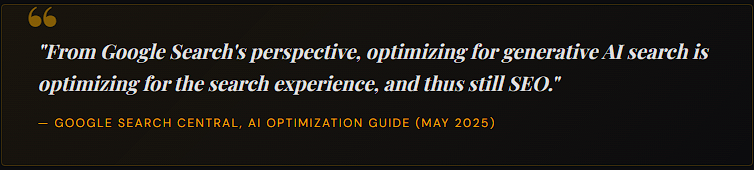
Translation: GEO is not a new discipline. It’s not a separate channel. It’s SEO applied to a new interface. That’s actually good news — because it means everything you’ve invested in SEO already has compounding value in the AI search era.
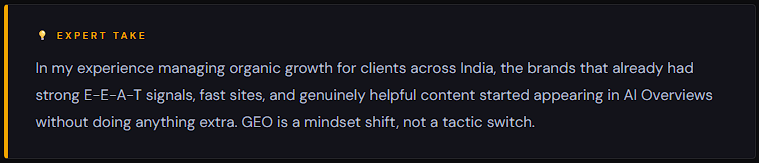
💡 Expert Take
2. Why Traditional SEO Is Still the Backbone of AI Search
Google’s generative AI features don’t work in isolation. They’re powered by two core systems that are deeply rooted in the existing Search infrastructure:
Retrieval-Augmented Generation (RAG)
RAG is the technical process behind AI Overviews. Google’s AI first retrieves the most relevant, high-quality pages from its Search index using its existing ranking systems, and then uses those retrieved pages to generate its AI response. This means: if your page doesn’t rank well, it won’t be cited in AI Overviews.
Query Fan-Out
When someone searches for something like “how to fix a lawn full of weeds,” Google’s AI model generates a dozen related sub-queries in the background — things like “best herbicides for lawns” and “remove weeds without chemicals.” It then pulls results for all of those. If your content answers the secondary questions that flow from a core topic, you have more surface area to appear in AI responses — without gaming anything.
📌 Key Insight
Build topic clusters around a core subject, answering the full spectrum of related questions, and you naturally optimize for query fan-out — which is how AI Overviews pull multi-source answers.

3. The Content Strategy That Gets Cited in AI Overviews
This is the section that matters most. Google was unusually specific about what kinds of content its AI systems favour. Here’s my interpretation of each signal with the practical implication for your content strategy.
1. Unique Point of View > Generic Summary
Google’s guide specifically calls out the difference between a first-hand review based on personal experience and a summary of existing content. The former has a better chance in AI search. Think about what only you can say — your own case studies, client results, original data, or a contrarian opinion that’s backed by real-world evidence.
2. Non-Commodity Content Is the New Moat
Google’s guide explicitly introduces the phrase “non-commodity content” as a quality benchmark. Here’s how they define it:
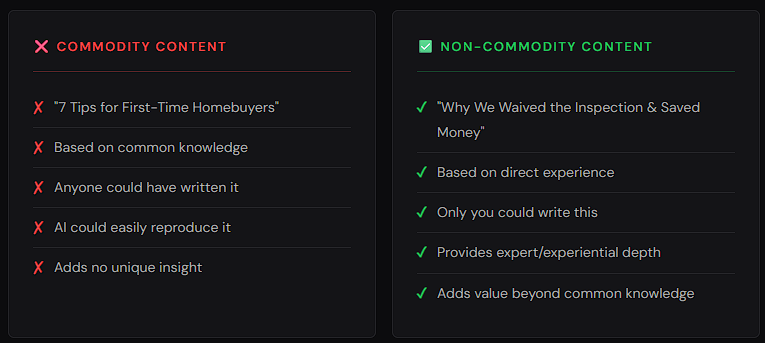
❌ Commodity Content
- “7 Tips for First-Time Homebuyers”
- Based on common knowledge
- Anyone could have written it
- AI could easily reproduce it
- Adds no unique insight
✅ Non-Commodity Content
- “Why We Waived the Inspection & Saved Money”
- Based on direct experience
- Only you could write this
- Provides expert/experiential depth
- Adds value beyond common knowledge
3. Structure Content for Human Readers — Not AI Bots
Google says clearly: write for your human audience. Use clear paragraphs, logical headings, and easy-to-follow flow. AI systems are capable enough to understand your content whether you write in short bullets or long prose — so optimize for what makes your reader’s experience better.
4. Support Text With High-Quality Images and Video
AI Overviews can pull in relevant images and videos — not just text links. If you’re publishing content without visual assets, you’re leaving real estate on the table. Follow Google’s image SEO best practices: descriptive file names, proper alt text, well-compressed original images. Do the same for video with structured data markup.
⚠️ Warning
Don’t create dozens of thin pages targeting every possible long-tail query variation just to capture fan-out queries. Google’s guide explicitly calls this out as a spam policy violation (scaled content abuse). It’s also ineffective — AI systems are now smart enough to see through it.
4. Technical SEO Requirements for Generative AI Features
To even be eligible to appear in AI Overviews, Google states your page must meet these baseline technical requirements.
Technical Requirements Checklist
- Indexed & eligible for snippets — Pages blocked by noindex or nosnippet tags are excluded from AI features.
- Crawlable HTML content — Ensure Googlebot can access your main content. If JavaScript renders key text, verify it’s processed correctly.
- Good Core Web Vitals — Page experience signals (LCP, CLS, INP) contribute to overall quality evaluation.
- Mobile-responsive design — Google uses mobile-first indexing. Non-mobile-friendly pages are at a structural disadvantage.
- Clean canonicalization — Eliminate duplicate content issues with canonical tags and proper URL structure.
- Semantic, accessible HTML — Not required to be perfect, but semantic HTML improves readability for AI agents accessing your site.
- Verified in Search Console — Essential for discovering crawling, indexing, and Core Web Vitals issues quickly.
5. 5 GEO Myths Google Just Officially Busted
There’s an enormous amount of noise in the SEO industry right now about things you “need” to do to rank in AI search. Google’s guide directly refutes many of them. Here’s the full myth-busting table:
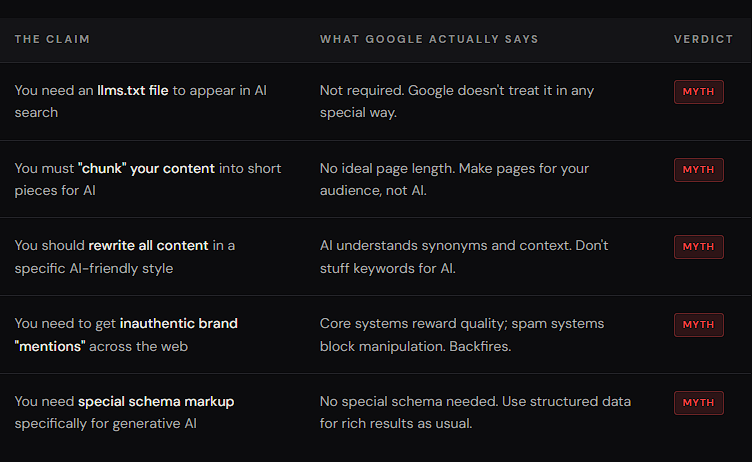
💡 My Take
I’ve audited dozens of sites that spent time on llms.txt files, AI-style content chunking, and “GEO agency” services. None of it moved rankings. The sites that gained visibility in AI Overviews were the ones that had invested consistently in E-E-A-T, page speed, and genuinely useful, first-person content. The fundamentals always win.
6. GEO Action Checklist — Steal This
Based on Google’s guide and my own experience, here’s the priority-ordered action checklist I’d hand to any client starting GEO work today:
🎯 Your GEO Priority Checklist
- 1. Audit your content for commodity vs. non-commodity. Flag any pages that are generic listicles with no original perspective. Rewrite the top-traffic ones with first-hand experience, original data, or a clear expert opinion.
- 2. Verify Search Console coverage. Check that your most important pages are indexed and serving snippets. Confirm no key pages are accidentally noindexed.
- 3. Fix Core Web Vitals fails. Run PageSpeed Insights on your top 10 pages. Pages failing LCP or CLS are at a disadvantage for both regular and AI search.
- 4. Add or improve visual content. Every major content piece should have at least one original, high-quality image with a descriptive alt tag. Add video where the topic suits it.
- 5. Build topic clusters, not keyword silos. Identify your 3-5 core topics and create interconnected content that answers the full set of questions users have about that topic.
- 6. Add FAQ schema to question-based content. While schema isn’t required for AI features, FAQ markup helps with rich results and signals to Google the Q&A intent of your page.
- 7. Review E-E-A-T signals. Do your pages show who wrote the content? Is there an author bio with credentials? Are sources cited? These signals matter more than ever in the AI era.
FAQ — GEO & AI Search Optimization
What is GEO (Generative Engine Optimization)?
GEO stands for Generative Engine Optimization — the practice of optimizing your website to appear in AI-generated search results such as Google’s AI Overviews and AI Mode. According to Google’s own documentation, GEO is simply a subset of SEO focused on the AI search experience. The same foundational practices that improve traditional rankings also improve AI visibility.
Does traditional SEO still work for AI Overviews?
Yes, absolutely. Google confirmed in its official AI optimization guide that AI Overviews and AI Mode use Retrieval-Augmented Generation (RAG) — meaning they pull from the same core Search index that powers regular rankings. Strong SEO signals (E-E-A-T, backlinks, technical health, content quality) directly influence whether your page gets retrieved and cited.
Do I need an llms.txt file to rank in AI search?
No. Google’s official guide explicitly states that llms.txt files, special AI markup, or Markdown files are not required and provide no advantage in Google’s generative AI features. Don’t waste time on these.
What type of content ranks best in AI Overviews?
Non-commodity, people-first content with a unique point of view. First-hand reviews, expert analysis, original research, and content that offers genuine insight beyond what’s already widely available online are more likely to be cited. Generic, recyclable content — especially content AI could have written itself — is less likely to appear.
Is structured data (schema markup) important for generative AI search?
Structured data is not required for generative AI features, but Google recommends continuing to use it as part of your overall SEO strategy. It helps with rich result eligibility in standard Google Search results, which indirectly supports your overall visibility.
How is “query fan-out” relevant to my content strategy?
Query fan-out is Google AI’s process of generating multiple related sub-queries to build a comprehensive AI answer. If your site has a topic cluster — several interlinked pages covering a topic from multiple angles — you have more opportunities to appear in the fan-out results that feed AI Overviews, even for searches that don’t exactly match your primary keyword.